Designed for beginners.
Algorithms aren't magic creating one is easy. Then we'll use it to solve the cube.
The Layer-by-Layer was designed for speedcubers; simplicity wasn't the constraint.
For beginners, the point is solving the cube. Speed will come later.
The Layer-by-layer can be easier with a new approach.
A few extra moves for understanding isn't heresy - it's teaching.
TAILORED: For those who tried without success or first-time solvers.
They will discover the cube is not that difficult if approached in the right way.
NOT DESIGNED: For speedcubers. Nothing here is about speed.
The reason for them to visit would be curiosity to explore a different perspective.
|
|
In a nutshell:
These three blocks are all the structure you need to solve the white cross.
Setup - Algorithm - Undo. Master this logic and the cube is yours.
The WB edge could be placed in 3 moves - but the goal here isn't to optimize moves, it's to optimize learning.
The workbench is a metaphor: it makes you think there is a place where you can operate without worrying about making a mess or causing damage.
With the Sledgehammer, you do two things:
1) Perform the move you had in mind - always the first rotation R. that makes it simple to remember and use.
2) The other 3 moves create a 'workspace' where side effects don't matter, keeping the rest of the cube safe.
The layer will not be fully solved. One corner stays empty, on purpose.
The strategy is to place only 3 white corner, one at a time. Layer 2 will make clear why
The corner at rdf remains clear. That one gap simplifies the classic LbL.
|
|
In a nutshell:
In the previous section we used 2 different sequences (R U' R' U) and (B' R B R'), sharing the same schema: Action, Protection, Undo, Undo
Both do the same job, but in a different way: the difference is the second rotation, and therefore the fourth.
Both share the same pattern: Action, Protection, Undo, Undo.
In the first section, after the setup move, if those four rotations seemed unreasonable - you were right! I should have used the Sexy Move (R U R' U') instead of the Sledgehammer (R U' R' U) (For teaching, the Sledgehammer was the right choice).
In the classic layer-by-layer method, when you need to solve the third layer, one setup move is enough to use the Sexy Move. To use the Sledgehammer, you need two setup moves.
For speedcubers, when speed matters, the Sexy Move wins.
Instead the Sledgehammer makes its effects easier to see (better than the Sexy Move). So, in a tutorial, For beginners, when clarity matters, the Sledgehammer wins.
The action is the first move of the required 'Sledgehammer'. The other moves follow.
Thinking in terms of 'Sledgehammer' makes solving the cube easier.
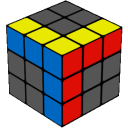
Corner orientation with the 'Sledgehammer'.
|
|
Once the corner is in place, to adjust orientation just repeat the 'Sledgehammer'.
The 'Y' shaped region is called 'Workbench'
Now will be clear why the first layer was left incomplete.
|
|
In a nutshell:
The Sledgehammer would remove the already-solved RWG corner. The D rotation swaps it with a disposable corner from rdf - so the Sledgehammer damages only what we don't care about.
Remains the case where the edge to place is trapped in Layer 2 .
Think about it: when we bring an edge from Layer 3 down to Layer 2, the edge that was already there gets kicked up to Layer 3 . Right?
That means:
The same move that inserts an edge can also free a trapped one.
Believe it or not, the worst is over.
Strategy:
|
|
In a nutshell:
This part is easy like the white cross. If you've got the idea behind it, you'll soon improvise.
Layer 3 is where most give up, even though the solution is disarmingly simple.
When positioning the first edge on the third layer, it seems natural to assume it can be placed in any of the four slots.
THAT'S WRONG!
Only two positions are valid - they lead to a successful resolution. The other two will result in a swap of the last two edges, making the cube impossible to solve
To resolve this, simply relocate the two edges OY and YG to their adjacent positions.
|
|
In a nutshell:
Once out of the trap, pick a Sledgehammer and repeat until all edges are in place.
|
|
In a nutshell:
I found this technique on the internet - no idea who came up with it.
The insight:
The Workbench is no longer usable? (Because the edges already occupy their slots)
No worries, define a 'new Workbench' to work on the 'old Workbench' . Easy!
The strategy:
The 'Sledgehammer' (F' R F R') can do the whole job till the end. Using (R F' R' F) also shortens the task.
Things to know:
|
|
|
|
|
|
In a nutshell:
Changing the 'Workbench' to this will solve this configuration.
Things to know:
This method relies on the fact that repeating the 'Sledgehammer' 6 times returns the cube to its original state. By splitting the cycle and inserting an F move, we can orient two different corners while keeping the 'Workbench' intact. Whether you finish with 4 more repetitions or use the inverse version twice, the cube will be fully restored.
|
|
|
|
|
|
| 1) | 2 2 times | (D' R D R') Sledgehammer Adjusts orientation of corner RWB at rdf |
| 2) | Setup moves corner RYB from ruf to rdf | |
| 3) | 2 2 times | (R D' R' D) Sledgehammer Adjusts the orientation of ruf |
| 4) | Setup Final rotation. Cancels the rotation from step 2 (F) |
The second 'Sledgehammer' the inverse of the first, cancels the effect of the first one and the cube returns to its original state in only 2 times.
How to reverse: Perform the moves in opposite order and opposite direction. If the move was D', the reverse is D. E.g. (D' R D R') ⬄ (R D' R' D)
The Workbench , is a new approach optimized for the Sledgehammer.
This solver implements the 'workbench' to solve step-by-step any scramble.
The solver is fully configurable!
And if you like puzzles: The game of 100
This isn't a static guide. Every move sequence is connected to a live 3D cube. Click any R U R' U' - the cube shows you exactly what happens.
Step forward one move at a time, Run one shot groups of rotations with
Run one shot groups of rotations with
Run the full sequence with
See the effect before you try it yourself. No memorization. Just watching, understanding, and solving.
This page contains an interactive 3D Rubik's Cube used to visualize algorithm sequences and cube transformations. Each move is animated so that users can observe how edge and corner pieces move across different cube states.
The demonstration focuses on the Sledgehammer move sequence, commonly used in multiple Rubik's Cube solving methods. The viewer allows inspection of the cube from any angle and helps users understand the effect of the algorithm on piece permutation and orientation.
The purpose of this visualization is educational. It helps users understand how Rubik's Cube algorithms transform the cube by tracking the movement of corners and edges during each move.
By observing the sequence repeatedly, users can learn how specific operators affect piece permutation and orientation within the cube.
The simulation demonstrates the Sledgehammer move sequence and shows how repeated application of the operator modifies the cube configuration.
Each move in the sequence is animated so that users can observe how the algorithm affects corner orientation, edge position, and overall cube structure.
Users can interact with the cube directly by rotating the model, inspecting the cube state, and replaying the move sequence. This allows the algorithm to be explored visually rather than only through notation.
The cube animation displays each move in sequence so that the effect of the algorithm can be observed gradually. This makes it easier to understand how complex transformations emerge from simple repeated operations.
This interactive demonstration provides a visual explanation of Rubik's Cube algorithms using a real-time 3D simulation.
Algorithmic Monism: The system is built entirely upon a single operator, the Sledgehammer, executed strictly within a setup → operator → undo-setup commutator-like sequence.
Structural Innovation: It introduces the "Workbench" concept (the Y-region): a controlled environment where cubies are processed individually, maintaining state-integrity across the rest of the puzzle.
Strategic Simplification: A notable advancement is the "sacrificial placeholder": deliberately leaving a multi-layer slot open to serve as a functional gateway for orientation and permutation.
Formal Proof of Completeness: The method's viability is not merely theoretical; its formal completeness is demonstrated by the solver functional solver, capable of resolving any arbitrary configuration using this single operator exclusively.
Empirical Verification: Integrated 3D engine and dynamic controls for real-time validation of algorithmic sequences and direct observation of state-integrity through interaction.